
For most of our working lives, retirement planning seems relatively straightforward:
Save. Invest. Grow. Repeat.
We contribute to 401(k)s, 403(b)s, IRAs and other retirement accounts. We diversify our investments and try to earn a reasonable rate of return while controlling risk. During the accumulation years, that makes sense.
But retirement fundamentally changes the problem. Once the paycheck stops, the question is no longer simply, “How do I maximize my investment return?” It becomes:
“How do I turn the wealth I accumulated into reliable income for an unknown number of years—while still maintaining enough liquidity and growth to deal with inflation, market volatility, health expenses and the unexpected?”
Those are very different problems. And a growing body of retirement-income research suggests that the traditional answer—keeping virtually everything invested and systematically withdrawing from the portfolio—may not always be the most efficient way to solve them.
“The integrated approach is actually able to provide more legacy wealth in these cases, while also supporting more retirement income. This is the meaning of greater efficiency. Readers may be surprised that it is not at all a clear-cut case that the upside growth potential of investments will be sufficient to beat a more integrated approach using actuarial science and mortality credits. Actually, the odds are against investments.”
Dr. Wade Pfau, Retirement Income Research
The better question may not be whether retirees should choose investments or guaranteed income. It may be how to use both to do different jobs.
The Problem With Treating a Retirement Portfolio Like a Paycheck
A traditional investment portfolio is an excellent tool for accumulating wealth.
But investments do not know how long you are going to live. That distinction matters enormously in retirement.
Imagine two retirees who each have $1 million. The first knows with certainty that he/she will live exactly 15 more years. The second could live anywhere from five years to 35 years. Those two people should not rationally spend their money the same way.
The second retiree has to protect against something financial planners call longevity risk: the possibility of living substantially longer than expected and exhausting his/her resources. That uncertainty creates a difficult tradeoff. Withdraw too much and you increase the possibility of running out of money. Withdraw too little and you may unnecessarily sacrifice the retirement lifestyle you spent decades saving to enjoy.
This is one reason researchers have studied lifetime income for decades. In April 2026, researchers including Olivia S. Mitchell of the Wharton School, Jeffrey Brown, Moshe Milevsky and several other prominent retirement researchers published The Annuity Puzzle Revisited: Barriers, Behavior, and Policy Paths to Lifetime Income through the National Bureau of Economic Research.
Their starting point is fascinating. Economic models have long suggested that retirees should have significant demand for lifetime annuities because annuities insure against longevity risk. Yet relatively few retirees actually purchase them. Economists call this disconnect the “annuity puzzle.”
The researchers point to complexity, behavioral biases, product design, framing, limited guidance and other barriers that can influence annuity adoption. In my experience, much of the resistance I hear—from consumers and advisors alike—is rooted less in the math than in emotion and in outdated assumptions about how annuities work today.
Wharton’s Pension Research Council was still discussing the issue in 2026, highlighting research into why retirees underutilize lifetime-income solutions despite their benefits. The question therefore isn't new, but it is becoming increasingly important as fewer Americans retire with traditional defined-benefit pensions.
Retirement Success Shouldn't Be Measured Only by the Account Balance
One of the biggest problems with retirement planning is how we define success. Consider two hypothetical retirees.
Retiree A dies at age 92 with $2 million remaining, but spent much of retirement worried about the stock market, restricting spending and wondering whether there would be enough money.
Retiree B dies with $800,000 remaining, but had predictable monthly income, traveled more, spent more comfortably on family and hobbies, and rarely worried about whether next month's income depended on the stock market.
Who had the more successful retirement? A spreadsheet might prefer Retiree A. The retirees themselves might answer differently.
One of the most common regrets I hear from retirees in their 80s and also what the research that was done found is that they held back in their 60s and early 70s—skipping trips, time with grandkids and experiences—out of fear of running out. By the time they realized they could have spent more, their health or energy no longer allowed it. That distinction is increasingly important in retirement-income research.
Guaranteed Income May Change the Way Retirees Actually Behave
David Blanchett and Michael Finke examined this question in research titled “Guaranteed Income: A License to Spend.” They studied how the form in which retirees hold wealth relates to how much they actually spend.
Their findings are striking. Retirees holding a greater proportion of their wealth in guaranteed income spent more than retirees with equivalent wealth held in investments. Their marginal estimates found that investment assets generated approximately half as much additional spending as wealth held in guaranteed income.
Why? Part of the answer is mathematical: a retiree drawing from investments has to protect against the possibility of living longer than expected. But there also appears to be a behavioral component.
People often think differently about spending income than they do about selling assets. A paycheck feels spendable. Watching a retirement account decline can feel like becoming poorer—even when withdrawals were the entire reason the account was accumulated.
Blanchett and Finke tested this behavioral preference separately. When participants were asked whether an additional $10,000 of annual income or $140,000 of additional wealth would make them more comfortable increasing discretionary spending, 59.4% selected the income.
59.4%
chose $10,000 of annual income over $140,000 of additional wealth as the thing that would make them more comfortable spending
That has enormous implications for retirement planning. The purpose of retirement savings isn't simply to accumulate the largest possible number.
At some point, those dollars are supposed to finance a life.
The Goal Isn't to Replace Investments With Annuities
This is where discussions about annuities frequently go off track. The argument should not be:
“Investments are bad. Annuities are good.”
Nor should every retiree put all of his/her money into an annuity. Both ideas miss the point. Investments and insurance solve different financial problems.
A diversified investment portfolio provides characteristics that annuities generally cannot replicate:
Growth potential. Liquidity. Flexibility. Inflation protection. Legacy potential.
Lifetime-income annuities provide something investments cannot guarantee:
Income that can continue regardless of how long the owner lives.
The objective therefore isn't necessarily choosing one. It is deciding which dollars should do which jobs.
“True retirement planning is the art of separating the need for income from the desire for growth—securing the former so you can capture the latter.”
Matthew J. Welt, RSSA®
Think About Retirement as an Income Floor Plus a Growth Portfolio
Suppose a retired household needs $10,000 per month to maintain its lifestyle. Social Security and pensions provide $6,500, leaving a $3,500 monthly gap.
One approach is to leave the entire retirement portfolio invested and withdraw $42,000 annually. That can work. But now a portion of the household's essential lifestyle depends on portfolio performance, and a significant market decline early in retirement can force withdrawals while investments are depressed—a phenomenon known as sequence-of-returns risk.
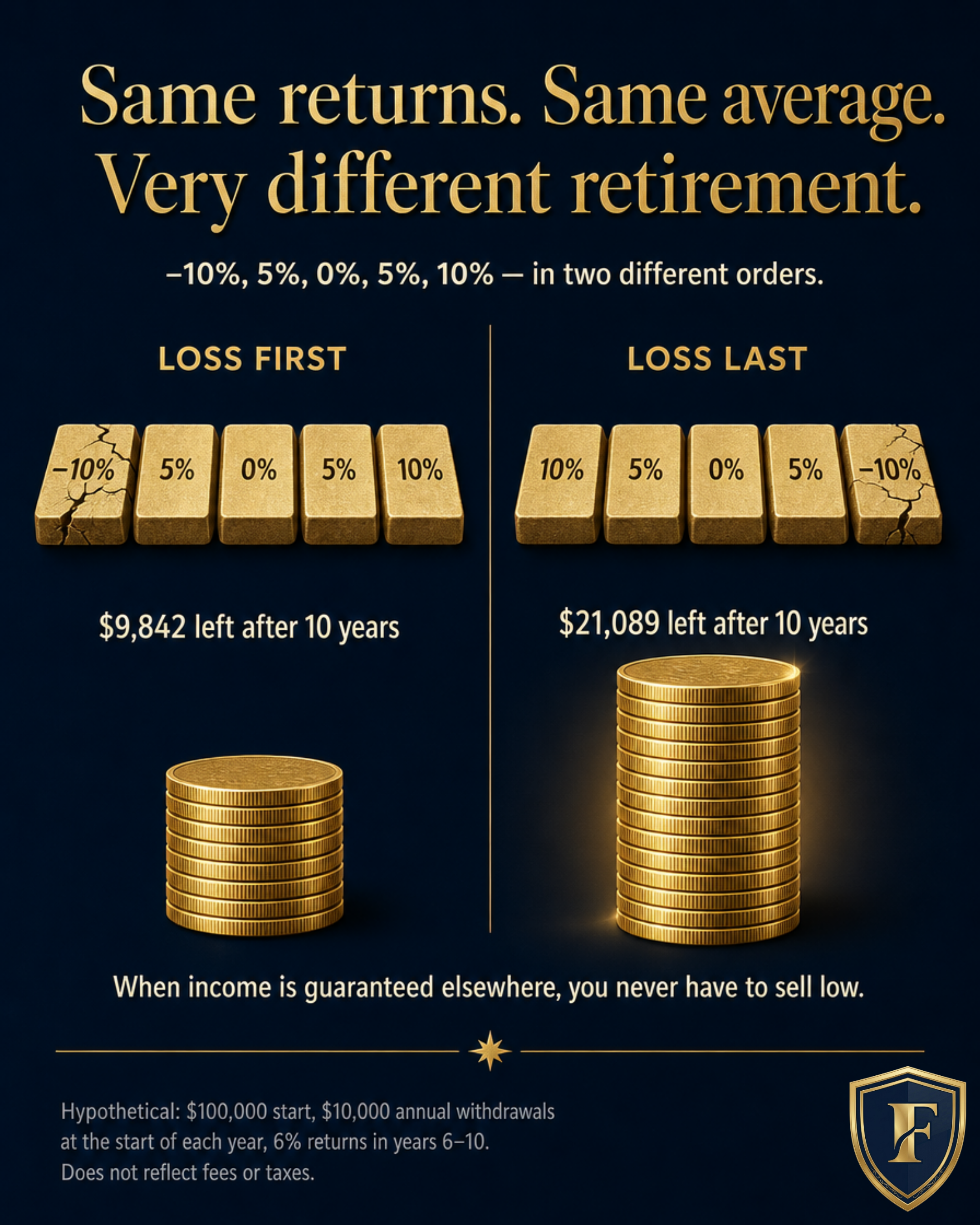
Here is how much the order of returns matters. Two hypothetical investors start with $100,000 and earn the same five annual returns—−10%, 5%, 0%, 5% and 10%—for an average of 2%. One experiences the loss first; the other experiences the same returns in reverse order. Years 6 through 10 earn a steady 6% for both.
| Scenario | Loss first | Loss last |
|---|---|---|
| Saving $10,000/yr, after 5 years | $166,290 | $157,885 |
| Saving $10,000/yr, after 10 years | $282,286 | $271,039 |
| Withdrawing $10,000/yr, after 5 years | $52,005 | $60,410 |
| Withdrawing $10,000/yr, after 10 years | $9,842 | $21,089 |
Hypothetical illustration only. Contributions and withdrawals occur at the start of each year. Does not reflect fees or taxes.
For a saver, an early loss actually helps slightly: it hits a smaller balance, and each new contribution buys in at lower prices. For a retiree, the same early loss is devastating. After 10 years, the retiree who experienced the loss first has less than half as much money left—with the identical average return and identical withdrawals.
The difference comes entirely from being forced to sell shares while they are down.
Another approach is to determine whether some portion of the retirement assets can efficiently create enough guaranteed income to cover some or all of that $3,500 gap. The remaining portfolio no longer has to perform every job simultaneously. It can be positioned primarily for:
- long-term growth,
- inflation protection,
- liquidity,
- discretionary spending,
- emergencies, and
- legacy.
That is a fundamentally different way of thinking about retirement. Instead of asking, “How much can I safely withdraw from my investments?” we can also ask:
“How much of my required lifestyle should depend on investment performance in the first place?”
The Double-Duty Problem
When one pool of money is responsible for everything, it ends up doing none of it especially well.
In the traditional withdrawal approach, a single portfolio is asked to handle all of these jobs at once:
- Produce income, which, in the de-accumulation years, is really just a withdrawal from a slowly growing account.
- Keep pace with inflation, which has been anything but steady.
- Absorb sequence-of-returns risk, surviving bad markets while still paying the bills.
- Manage longevity risk, lasting for an unknown number of years.
Inflation alone shows how hard that is. From 1980 to 1999, consumer prices rose about 4.2% per year on average. Shift the window just five years, to 1985–2004, and the average falls to roughly 3%. A retiree cannot choose which inflation era he/she retires into—and either way, it steadily erodes the purchasing power of cash and conservative assets.
To cope with all of that, the typical response is to make the whole portfolio more conservative. That lowers volatility, but it also lowers the growth the portfolio needs to fight inflation over a 25- or 30-year retirement.
It is a compromise built into the design: the account is too conservative to grow like an investment portfolio and too volatile to be as dependable as a paycheck.
The era a retiree lands in can matter as much as the portfolio itself. Consider the last two complete 20-year periods:
| 20-year period | S&P 500 CAGR | 60/40 CAGR | Avg. inflation |
|---|---|---|---|
| 1980–1999 | 17.88% | 14.47% | ~4.2% |
| 2000–2019 | 6.06% | 6.24% | ~2.16% |
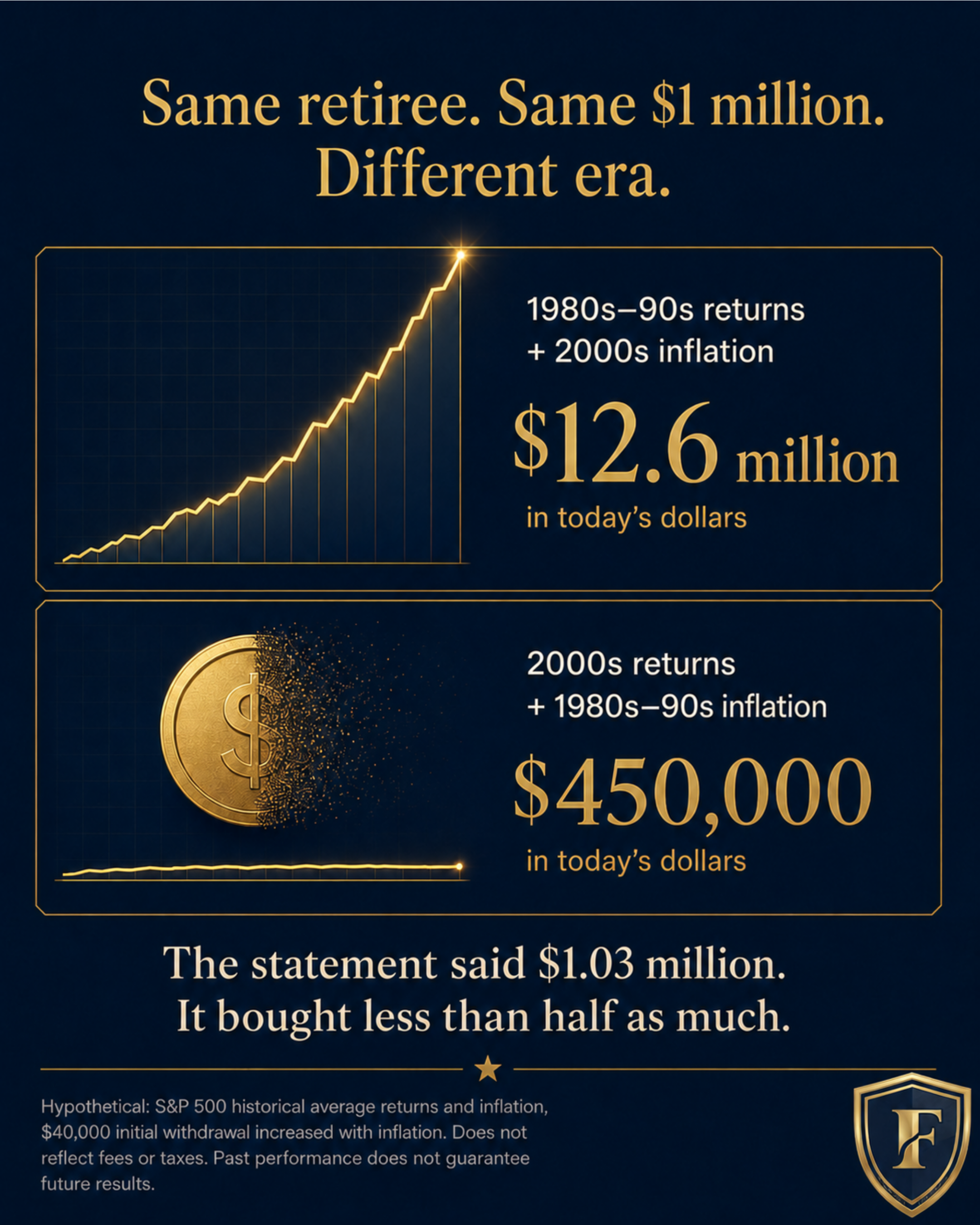
Now swap them. Pair the strong returns of 1980–1999 with the mild inflation of 2000–2019, and the S&P 500’s real (after-inflation) return is about 15.4% per year. Pair the weaker returns of 2000–2019 with the higher inflation of 1980–1999, and the real return falls to about 1.8%.
For a hypothetical retiree with $1 million, invested in the S&P 500 and withdrawing $40,000 in year one with inflation increases each year:
| Scenario | Real return | Balance after 20 years (today’s dollars) |
|---|---|---|
| 1980–99 returns + 2000–19 inflation | ~15.4% | ~$12.6 million |
| 2000–19 returns + 1980–99 inflation | ~1.8% | ~$450,000 |
Hypothetical illustration using historical average annual returns and inflation. Does not reflect fees or taxes. Past performance does not guarantee future results.
In the second case, the account statement would still show roughly $1.03 million after 20 years. It looks as though the retiree held steady. But that money buys less than half of what it did at the start.
And those figures assume smooth average returns. The actual 2000–2019 period opened with the 2000–2002 bear market and was followed by 2008—a sequence that would have made the real-world outcome worse.
This is also why guaranteed income alone isn't the whole answer: a fixed annuity payment loses purchasing power to inflation, too. The solution is to let each dollar do its job. The annuity covers the income floor, so the growth portfolio can stay invested and do the work of outpacing inflation.
Why This Can Potentially Make the Investment Portfolio Better, Too
This point is often overlooked. Consider a hypothetical retiree with $1 million who wants dependable income.
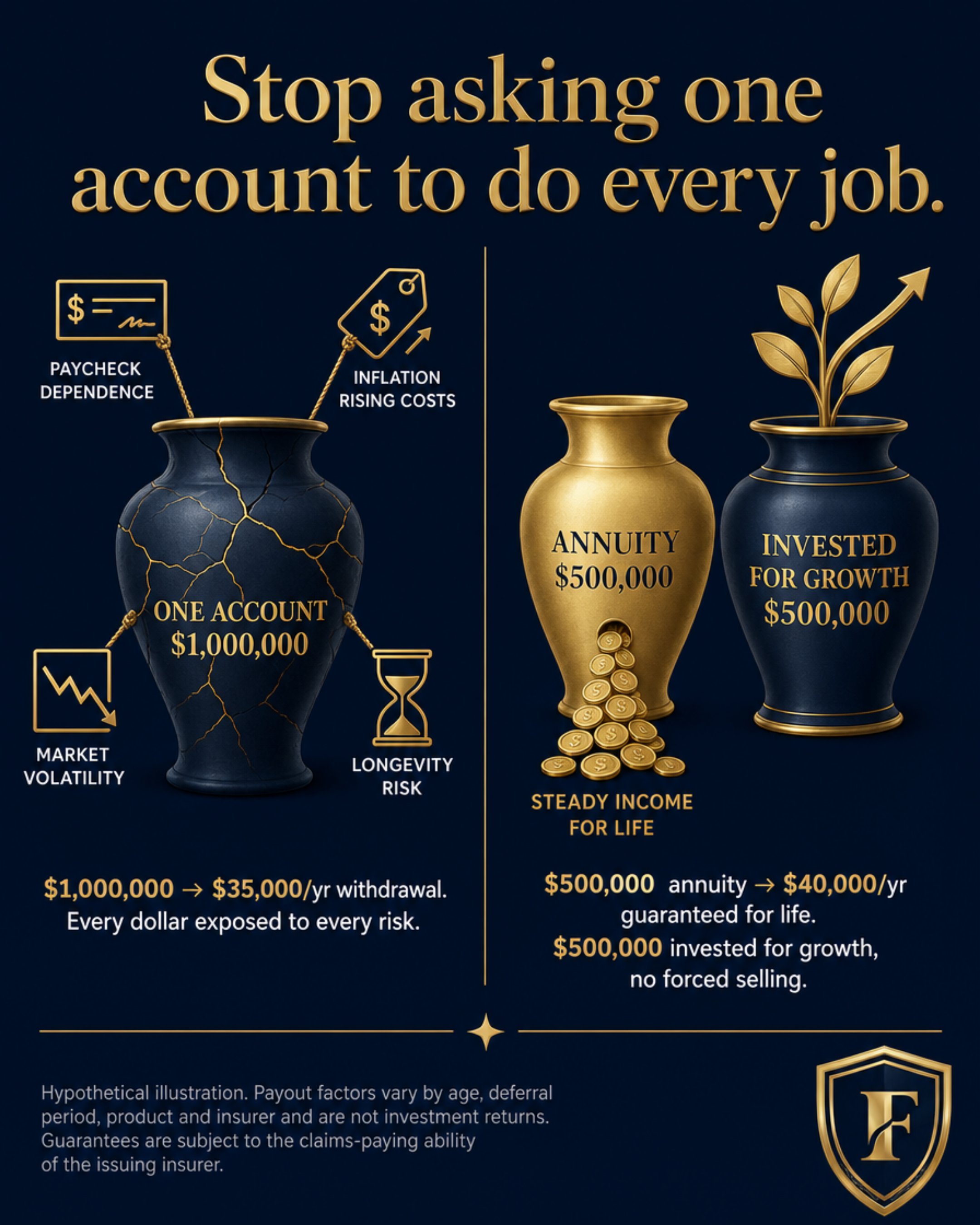
Approach 1: One account does everything. The full $1 million stays in a conservative, “slow accumulation” allocation, and the retiree withdraws 3.5% per year—about $35,000. Every dollar is exposed to every risk.
Approach 2: Separate the jobs. $500,000 goes into a lifetime-income annuity with a guaranteed payout factor of 8%, producing about $40,000 per year for life. The other $500,000 is invested for growth.
| One account | Separated | |
|---|---|---|
| Assets producing income | $1,000,000 | $500,000 |
| Annual income | ~$35,000 (withdrawal) | ~$40,000 (guaranteed for life) |
| Assets free to grow | None; all serving income | $500,000 |
| Forced to sell in a down market? | Yes | No |
Hypothetical illustration only. Actual payout factors vary by age, deferral period, product and insurer; an 8% payout reflects specific ages and deferral periods and is not an investment return, as payments include a return of the original premium.
In the second approach, the remaining $500,000 doesn't need to generate the paycheck. The annuity is doing that job.
Because there is no month-to-month or year-to-year need to draw on it, that money can potentially stay invested with a much longer time horizon—for many retirees, a substantially higher equity allocation than a withdrawal-dependent portfolio could tolerate. It can ride out volatility because the income is already coming from somewhere else.
History has been kind to patient equity investors. Wharton professor Jeremy Siegel’s long-term research, published in Stocks for the Long Run, found that over rolling 20-year periods, stocks outperformed bonds in the overwhelming majority of cases.
The catch is that you have to stay invested long enough to collect that reward. A retiree who must sell shares during a downturn to fund living expenses locks in losses and has fewer shares left to participate when the market recovers.
When guaranteed income covers the paycheck, there is no forced selling of principal in down years. Every share stays in place for the rebound—and the retiree’s lifestyle never has to change because of what the market did last quarter.
The research backs this up. Retirement researcher Jamie Hopkins, writing in Forbes, summarized several studies pointing in the same direction:
- Research by John Ameriks, Robert Veres and Mark Warshawsky found that adding an immediate annuity to a retirement portfolio lowered portfolio failure rates across every time period and every portfolio mix they tested.
- Dr. Wade Pfau’s efficient-frontier research found that the most efficient way to balance meeting spending goals with preserving assets was to combine stocks with fixed income annuities—not the traditional stock-and-bond portfolio.
- Additional research from Dr. Pfau found that adding an annuity increases a retiree’s “true liquidity.”
That last point runs against intuition, so it is worth unpacking. Without an annuity, a retiree’s investments aren’t really liquid—they’re spoken for. Every dollar is quietly earmarked for future income, so spending it today means shortchanging tomorrow.
Once an annuity covers the income floor, the remaining assets are no longer on the hook for the paycheck. They become genuinely available for travel, emergencies, gifts or opportunities—and can stay invested for growth in the meantime.
In other words, the annuity doesn’t just change how retirees feel about spending. It changes what the rest of their money is free to do.
But something important has changed. Guaranteed income doesn't necessarily compete with an investment portfolio. Properly structured, it can potentially allow the investment portfolio to focus on what investments do best: long-term growth.
Then Why Don't More People Own Annuities?
This is precisely the “annuity puzzle” researchers have spent years trying to understand. Wharton research has examined behavioral obstacles including mental accounting—the tendency to evaluate the annuity as an isolated investment or gamble rather than evaluating how it affects the retirement income plan as a whole.
That distinction is important. If you compare an annuity with the S&P 500 solely by asking, “Which one has the higher expected return?” the comparison is incomplete. It would be similar to evaluating homeowners insurance based on its investment return.
Insurance isn't primarily purchased to maximize expected return. It is purchased to transfer a risk the household doesn't want to bear. With lifetime-income annuities, the risk being transferred is primarily longevity risk, and the insurer pools that risk across many policyholders.
The Financial Industry Has Another Structural Problem
For decades, the financial-services industry has been built primarily around accumulation. Investment management naturally focuses on assets under management, portfolio construction, asset allocation and investment performance. Those are extremely important disciplines.
But retirement income planning requires another layer. A retiree doesn't simply need a portfolio—a retiree needs an income system. And that system may need to address:
longevity risk, market risk, sequence risk, inflation, taxes, healthcare costs, long-term care, liquidity and legacy objectives—all simultaneously.
No single financial product solves all of those problems. That is exactly why retirement planning should not begin with a product. It should begin with identifying the risks.
Long-Term Care Exposes the Same Problem
Long-term care provides another example of why retirement planning needs to evolve beyond simply accumulating a large portfolio. Traditional long-term-care insurance was designed to transfer the financial risk associated with needing extended care.
The concept makes sense, but the implementation has sometimes been difficult. Traditional policies can involve substantial premiums, potential premium increases and the possibility that someone pays premiums for many years but dies without needing long-term care.
AARP noted in 2026 that only an estimated 3% of adults age 50 and older had some form of long-term-care insurance. It also highlighted the growth of hybrid products combining life insurance and long-term-care benefits; according to research it cited, sales of combination products had surpassed sales of traditional stand-alone LTC policies.
Morningstar reported a similar trend in September 2026, noting declining popularity of stand-alone LTC policies amid rising premiums and difficult consumer claims experiences while combination life/LTC and annuity/LTC products have grown substantially.
From “Use It or Lose It” to Multiple Potential Outcomes
Modern hybrid strategies can approach long-term-care risk differently. Depending on the specific product, a life-insurance policy may provide access to benefits during the insured's lifetime for qualifying chronic illness or long-term-care needs. That creates multiple potential outcomes:
If care is needed: qualifying benefits may help pay for care.
If care isn't needed: a death benefit may ultimately pass to beneficiaries.
Some hybrid annuity/LTC designs similarly provide long-term-care leverage while retaining other policy value. That can make the psychology of purchasing protection dramatically different from traditional “use it or lose it” coverage.
But hybrid policies aren't automatically better or cheaper. Traditional LTC insurance can sometimes provide significantly more pure long-term-care coverage per premium dollar. Hybrid policies can require substantial upfront capital, and chronic-illness riders are not necessarily equivalent to qualified long-term-care insurance.
The correct solution depends on the client's health, age, assets, cash flow, tax situation, desired benefits and legacy goals. Again, the answer isn't a particular product.
It's risk allocation.
A Different Way to Build a Retirement Plan
Instead of treating the entire retirement nest egg as one giant investment portfolio, consider dividing the retirement problem into separate objectives.
Income
Social Security, pensions and appropriately structured guaranteed-income solutions can provide a foundation of predictable income.
Growth
A diversified investment portfolio can provide long-term appreciation, inflation protection and flexibility.
Liquidity
Cash and liquid investments can cover emergencies, large purchases and opportunities without forcing the liquidation of long-term assets.
Long-Term Care
Traditional LTC insurance, hybrid life/LTC insurance, chronic-illness benefits, annuity/LTC solutions or intentional self-funding can address the potentially enormous cost of care.
Legacy
Investments, Roth assets, life insurance, trusts and other estate-planning strategies can be coordinated around what the retiree actually wants to leave behind.
Once retirement is viewed this way, the conversation changes. You're no longer asking which single product has the highest return. You're determining which financial tool is best suited to each financial risk.
Retirement Is Not an Accumulation Contest
During your working years, maximizing long-term risk-adjusted growth may be one of your primary objectives. Retirement is different.
A 68-year-old doesn't necessarily care whether his/her portfolio beat an index last year.
He/she cares whether there’s money for the trip the couple has talked about for 20 years.
He/she cares whether the mortgage gets paid if the market falls 30%.
He/she cares whether there’s room to help the grandchildren.
He/she cares whether a spouse will remain financially secure if he/she dies first.
He/she cares whether a nursing-home stay will dismantle the estate they spent 40 years building.
And perhaps most importantly, he/she wants to know:
“Am I actually allowed to spend this money?”
Research increasingly suggests that the structure of retirement wealth can influence the answer to that question. Retirees with guaranteed income appear more willing to spend. Economic research continues to recognize the value of pooling longevity risk. And the financial industry continues developing ways to transfer risks such as longevity and long-term care that an investment portfolio alone cannot eliminate.
None of that means every retiree should purchase an annuity. It doesn't mean investments should be abandoned. And it certainly doesn't mean every insurance product is appropriate.
It means retirement planning deserves to move beyond the false choice between insurance and investments.
The Retirement Plan of the Future May Look More Like a Personal Pension
For previous generations, retirement often included Social Security plus a pension. The pension provided a paycheck, and investments supplemented it.
Today, millions of retirees reach retirement with substantial 401(k) or IRA balances but relatively little guaranteed income beyond Social Security. We've effectively asked individual retirees to become their own pension managers.
They must determine how much to withdraw, how aggressively to invest, how long they will live and how much they can safely spend—all while navigating market crashes, inflation, taxes and potentially significant healthcare expenses.
Perhaps the next evolution of retirement planning isn't finding a better withdrawal rule. Perhaps it is recognizing that not every retirement risk should remain inside the investment portfolio.
The strongest retirement plan may combine several tools:
Guaranteed income for the money you cannot afford to outlive.
Growth assets for the money you want working for the future.
Liquidity for the money you may need tomorrow.
Insurance for risks you don't want your portfolio to absorb.
The objective isn't to die with the largest account statement. It's to build a retirement in which your money reliably supports the life you spent decades working to create.
That's the difference between simply having retirement assets—and having a retirement income plan.
This article is for educational purposes only and is not intended as individualized investment, tax, legal or insurance advice. Annuities and life insurance are insurance products. Guarantees are subject to the claims-paying ability of the issuing insurer. Annuities may contain surrender charges and other restrictions, and withdrawals from tax-qualified accounts may be subject to ordinary income taxes and other applicable tax rules. Annuity payout factors are not investment returns; payments include a return of premium, and payout factors vary by age, deferral period and product. Past performance of any market index is not a guarantee of future results. Long-term-care and living-benefit provisions vary significantly by contract and should be evaluated based on individual circumstances.