
When you are building wealth during your working years, the math is straightforward: accumulate assets, ride the market's long-term upward trajectory, and maximize growth. But the moment you transition from accumulating wealth to distributing it, the financial rules of gravity completely change.
In retirement, you no longer just face market risk—you face Sequence of Returns Risk (the risk of a market crash early in retirement forcing you to sell assets at a loss) and Longevity Risk (the risk of outliving your money). Traditional financial advice attempts to solve this by forcing your portfolio into a "healthy looking" but fragile structure, relying on the classic 4% rule and heavy bond allocations. However, pioneering peer-reviewed research by Dr. Wade Pfau and Dr. Michael Finke reveals that true financial health requires looking beneath the surface. To allow your investments to truly flourish, you must optimize your retirement's Base Metabolism and build a financial Immune System.
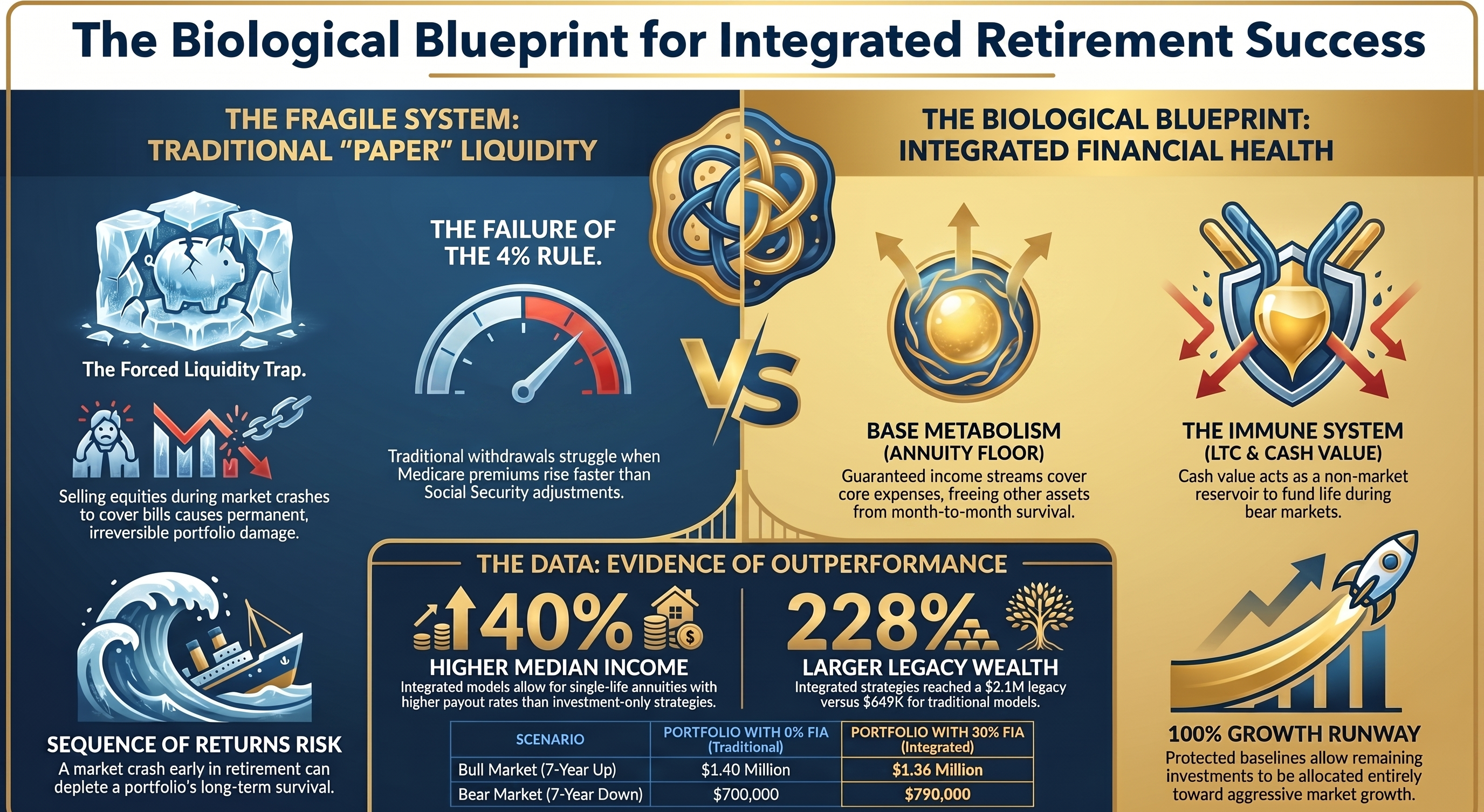
The metabolic framework: Balancing the guaranteed income floor with asset protection tools.
1. The Anatomy of Financial Health: Metabolism vs. Immune System
To understand why a portfolio of purely equities and traditional bonds is structurally ill-equipped for retirement, it helps to use a biological analogy.
Your Base Metabolism (The Annuity Floor)
In human biology, your metabolism is the baseline energy your body requires just to stay alive at rest. In retirement, your Base Metabolism represents your core, non-negotiable living expenses—housing, healthcare, food, utilities, and basic lifestyle needs.
The traditional 4% rule assumes a stable, predictable inflation rate, historically covered by things like Social Security and stable pensions. But today, the cost of living is highly volatile. If Medicare premiums jump by 4.5% while Social Security COLA (Cost of Living Adjustment) only increases by 2%, your lifestyle forces you to accelerate your withdrawal rate faster than the 4% rule ever anticipated.
By utilizing an insurance company annuity contract, you establish a guaranteed income stream that can yield 7% to 8.5% in cash flow capacity via contractual risk pooling, compared to the rigid 4% safe withdrawal rate. This handles your base metabolism contractually, freeing your remaining assets from the burden of month-to-month survival.
Your Immune System (LTC & Cash Value)
A person can look perfectly healthy on the outside but have a compromised immune system, making them entirely vulnerable to an unexpected virus. Similarly, a retiree can have millions in "assets," but if those assets are unprotected, the portfolio cannot withstand a market downturn combined with sudden spending needs.
A hybrid Long-Term Care (LTC) plan built with cash value life insurance acts as your financial Immune System. It provides two crucial layers of protection:
- LTC Protection: It shields your investments from being completely liquidated to pay for late-life healthcare crises.
- The Volatility Buffer: The cash value acts as a completely liquid, non-market-correlated reservoir. When the equity markets get sick (bear markets), your immune system kicks in, allowing you to bypass the market entirely.
2. The Great Misconception: Why Insurance and LTC Make You MORE Liquid, Not Less
The most common objection to incorporating annuities, permanent life insurance, and hybrid LTC into a retirement plan is the fear of tying up money. Critics claim insurance products lock up your capital, rendering you "illiquid." This is a fundamental misunderstanding of how an integrated portfolio operates.
True liquidity is not just about whether you can sell an asset; it is about whether you can sell it without destroying its structural value. If you own $2 million in equities during a 30% market crash, you are technically liquid because you can sell those shares on any business day. However, if you are forced to sell those shares at a massive loss just to cover your monthly mortgage or an unexpected emergency, you are committing financial suicide. You have "forced liquidity," which permanently alters your future compounding track and locks in irreversible losses.
"Without an annuity, assets are typically invested for future income and gains, so they are not really fully available for annual spending and true liquidity needs. By adding an annuity into the mix, liquidity and spending capabilities can actually be increased." — Dr. Wade Pfau
When you shift traditional, volatile fixed income into "Actuarial Bonds" (the combination of permanent whole life insurance and income annuities with an average maturity matching life expectancy), you unlock a completely different level of liquidity across two dimensions:
Eliminating Forced Liquidations
By establishing a contractual income floor with an annuity, your day-to-day survival is paid for. If the stock market drops 20% in your first year of retirement, you don't touch your stocks when they are down. Instead, you can contractually borrow against your life insurance cash value or leverage your hybrid LTC policy to absorb shocks. Your equities are given an unbroken, uninterrupted runway to stage a rapid recovery.
A 100% Growth Runway for Market Assets
Because your baseline income is completely covered by your annuity metabolism, and your emergency buffer is fully protected by your cash value immune system, your investment portfolio achieves true liquidity. You have zero short-term dependence on your equities. They can be allocated 100% toward working-years growth—index funds, mutual funds, and ETFs—without the fear that a market correction will force you to change your lifestyle.
3. What the Unbiased Research Proves
The data supporting this integrated approach isn't just theoretical; it is backed by exhaustive Monte Carlo simulations and historical market analysis from the industry's top economists.
Dr. Wade Pfau’s Efficient Frontier Studies
Dr. Pfau's research compared a standard "Buy Term and Invest the Difference" (BTID) strategy against an integrated model combining investments, a single-life annuity, and whole life insurance. The results show that the integrated approach successfully breaks the traditional financial tradeoff:
- 40% Higher Median Income: Because the permanent life insurance policy guarantees a death benefit legacy floor for heirs, retirees can comfortably choose a single-life annuity (which pays significantly higher rates than joint-life alternatives). This boosted median retirement income by 40% over investment-only strategies.
- 228% Larger Legacy Wealth: Traditional financial wisdom says you must sacrifice your legacy if you spend more in retirement. The data proves the opposite. By age 100, the median legacy wealth of the integrated approach reached $2,132,234—compared to just $649,780 for the investment-only strategy.
The Ibbotson & BlackRock Volatility Metrics
Research from economist Roger Ibbotson and asset managers like BlackRock heavily supports the integration of fixed index annuities (FIAs) as a superior alternative to traditional fixed income. BlackRock's research highlights that in consistently negative markets, an allocation to an FIA significantly protects wealth while preserving upside potential during bull runs:
| Scenario | Portfolio with 0% FIA (Traditional) | Portfolio with 30% FIA (Integrated) |
|---|---|---|
| Bull Market (7-Year Up) | $1.40 Million | $1.36 Million (Minor 3% drag) |
| Bear Market (7-Year Down) | $700,000 | $790,000 (13% Improvement) |
Furthermore, historical data compiled by financial researcher Jack Marrion tracking a 50-year period (1960–2010) proved that eliminating downside market losses completely outperforms standard market tracking over the long term, even when dividends are included:
- S&P 500 (No Dividends): $18,615
- S&P 500 (With Dividends): $84,260
- No Losses (Indexed Dynamic Strategy): $179,624
4. Live the Retirement You Actually Wanted
Ultimately, financial planning isn't just about spreadsheets; it's about freedom. When your retirement asset architecture has a healthy metabolism and a bulletproof immune system, the psychological burden of market volatility completely evaporates.
When the markets are up, your uninhibited index funds and equity portfolios flourish, giving you the green light to spend more, travel deeply, or take your kids and grandkids on an unforgettable trip. You don't have to look over your shoulder at a volatile ticker symbol because your living checks are contractually arriving no matter what.
And if the market suffers a severe down year? Your lifestyle doesn't shrink. You don't have to cut back on spending or postpone your plans. You simply let your equities sleep, draw from your fully liquid life insurance cash value buffer, and let your market wealth naturally grow back faster. You have successfully designed a portfolio that doesn't just look liquid on paper, but possesses the internal structural health to thrive across a lifetime.
Conclusion: The Grandparent’s Dividend
Strip away the academic whitepapers, the math formulas, and the economic jargon, and retirement comes down to one simple goal: permission to stop worrying.
When you spend your working life watching the markets and accumulating a nest egg, it is incredibly difficult to turn off that analytical switch. Traditional plans keep you trapped in that hyper-vigilant loop—forcing you to check the daily market tickers just to find out if you can afford to take your family out to dinner or buy that special birthday gift for your grandkid. Every headline about inflation or a market dip feels like a personal threat to your security.
By shifting to an integrated strategy, you are choosing a simpler, more peaceful path.
When your baseline living expenses are permanently automated by a contract, and your healthcare needs are securely insulated from your investments, you finally gain complete emotional liquidity. You no longer have to care what the stock market does on any given Tuesday.
If the markets soar, your growth portfolio expands, giving you extra capital to spoil your family, fund a grandchild's college account, or book that big family vacation. If the markets plunge, your day-to-day lifestyle remains perfectly untouched. Your monthly checks arrive on time, your bills are quietly paid, and your focus stays entirely where it belongs.
You earned your retirement. You shouldn't have to spend it managing market stress. By establishing a financial engine that runs itself, you gain the ultimate dividend: the ultimate freedom to just be "Mom," "Dad," "Grandma," or "Grandpa"—fully present, completely secure, and entirely worry-free.
Optimize Your Retirement Engine
Ready to build a structural floor that protects your growth and frees your time for what matters most? Let's trace your baseline income blueprint.