
Imagine two teachers. Both work 30 years. Both save in a 403(b). Both retire with a pension.
On paper, their retirements look almost identical. In practice, they could hardly be more different.
One may have no Social Security from teaching at all. One pension may rise a little each year while the other never rises. The 403(b) may have quietly lost a third of its growth to fees. And how much of each dollar the retiree actually keeps can depend entirely on which account it came from and which state he/she lives in.
Yet much of the retirement advice educators receive treats all of that income the same way: add it up, apply a withdrawal rule, pick an allocation.
That approach misses what makes public-sector retirement different. And the gaps usually don't show up on day one. They show up ten or fifteen years into retirement, when they are hardest to fix.
The 403(b) Was Supposed to Fill the Gap
For generations of educators, the pension was meant to be the foundation of retirement: a lifetime paycheck earned through years of service.
The 403(b) was meant to be the supplement. It gave teachers and other school employees a way to save on their own, pre-tax, to cover what the pension couldn't—to help make them whole.
That idea still makes sense. For an educator whose pension doesn't keep pace with inflation, or who won't receive Social Security from teaching years, a well-built 403(b) can be exactly the piece that closes the gap.
The problem is what the 403(b) became.
How the 403(b) Got Complicated
Public school 403(b) plans are exempt from ERISA, the federal law that sets fiduciary standards for most private-sector 401(k) plans. That means school districts generally don't carry the same duty to vet investment options that a private employer would.
Many districts simply approve a list of vendors and leave the choice to employees. Over time, much of that money flowed into insurance-company annuity products. Advisor Tony Isola has estimated that roughly 70% of non-ERISA 403(b) assets sit in annuities, with average fees of around 2%.
Most of those products are variable annuities, and their costs come in layers:
- Mortality and expense (M&E) charges. In many older variable annuity contracts sold in schools, the base M&E charge ran about 1.25% to 1.34% per year, with some contracts reaching roughly 1.5% or more once enhanced death benefits were added.
- Fund expense ratios on the investment options inside the annuity, which ranged from about 1% to over 3% per year.
- Administrative fees, rider charges and surrender charges that can apply on top.
Stack those together and a teacher in a high-cost contract could easily be paying 3.25% to 3.5% or more every year—whether the market is up or down.
Now compare that with a typical corporate 401(k). Most large employers work with well-known, low-cost providers—names most people would recognize—and offer broad index funds that cost just a few hundredths of a percent a year. Fees are disclosed in plain terms, and the employer has a legal duty under ERISA to monitor them.
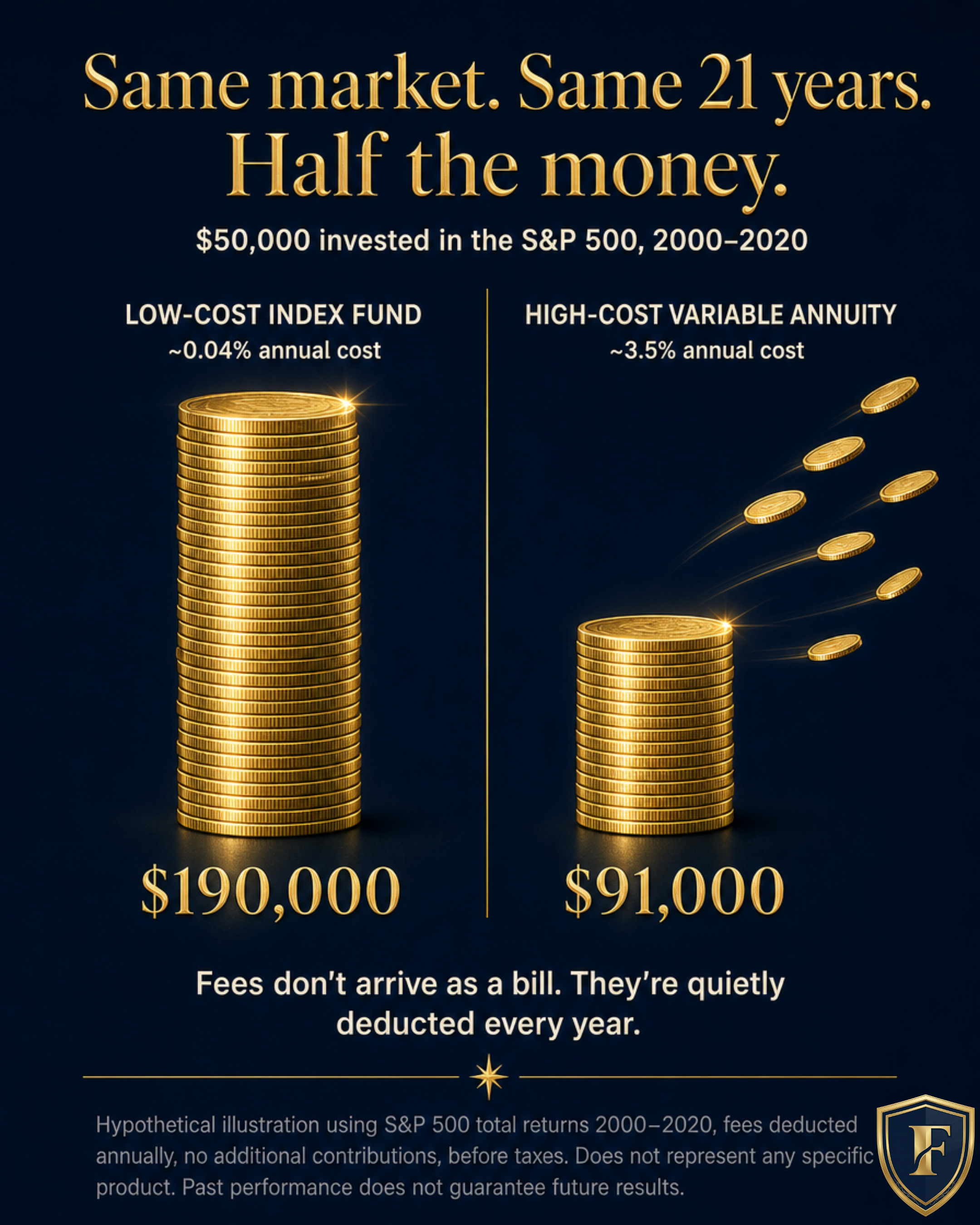
Same market, same investment, very different outcome:
| Total annual cost | $50,000 invested in the S&P 500, 2000–2020 |
|---|---|
| ~0.04% (low-cost index fund, typical of a well-run 401(k)) | ~$190,000 |
| ~2.0% | ~$126,000 |
| ~3.0% (high-cost variable annuity) | ~$101,000 |
| ~3.5% (high-cost variable annuity) | ~$91,000 |
Hypothetical illustration using S&P 500 total returns from 2000 through 2020, with fees deducted annually, no additional contributions and before taxes. Does not represent any specific product or provider. Past performance does not guarantee future results.
Same market. Same 21 years. At a 3.5% total annual cost, the teacher ends up with less than half of what a low-cost index fund would have produced—about $99,000 that went to fees instead of retirement.
California is one of the few states that has tried to shine a light on this. State law requires 403(b) vendors serving California public schools to register with CalSTRS, which runs 403bCompare, a public tool that lets educators compare fees, performance and services side by side.
Elsewhere, the fees have been much harder to see—and in at least two cases, federal regulators found that major variable annuity providers in the school market weren't giving teachers the full picture.
In July 2022, Equitable agreed to pay $50 million to settle SEC fraud charges over account statements sent to about 1.4 million variable annuity investors, most of them public school teachers and staff. According to the SEC, the statements typically listed fees of $0.00 while detailing less than 3% of the revenue Equitable actually collected from those contracts.
In July 2020, VALIC Financial Advisors agreed to pay about $40 million to settle SEC charges that it failed to disclose payments to a company owned by Florida teachers' unions in exchange for promoting VALIC, and failed to disclose conflicts tied to steering clients into more expensive mutual funds. VALIC settled without admitting or denying the findings.
In both cases, the people affected were teachers and school employees who trusted that the options offered through their school district had been vetted—and who had little idea what they were actually paying.
That is the heart of the problem. Fees don't arrive as a bill. They are quietly deducted from returns, year after year, and the damage only becomes visible decades later.
That doesn't mean every annuity in a 403(b) is a bad product. Fixed and fixed indexed annuities work very differently from variable annuities, and guaranteed income can play a valuable role in retirement. The issue is cost, transparency and whether the product actually fits the job it's being asked to do.
Many Educators Don't Pay Into Social Security at All
In a number of states, public school employees are covered by a state pension instead of Social Security. California, Colorado and most of Texas are among them. In Texas, the Texas Retired Teachers Association has estimated that about 95% of school employees don't pay into Social Security.
For years, that created a second problem. Educators who also worked in Social Security–covered jobs, or who were eligible for spousal or survivor benefits, often saw those benefits cut by the Windfall Elimination Provision (WEP) and the Government Pension Offset (GPO).
That changed on January 5, 2025, when the Social Security Fairness Act was signed into law, repealing both provisions. For many educators with two careers, or with a spouse who paid into Social Security, that repeal meant a meaningful increase in benefits.
But repeal didn't make a pension and Social Security the same kind of income. They still adjust for inflation differently. They are still taxed differently. And they still play very different roles in a retirement income plan.
COLAs: Where Two Pensions Stop Looking Alike
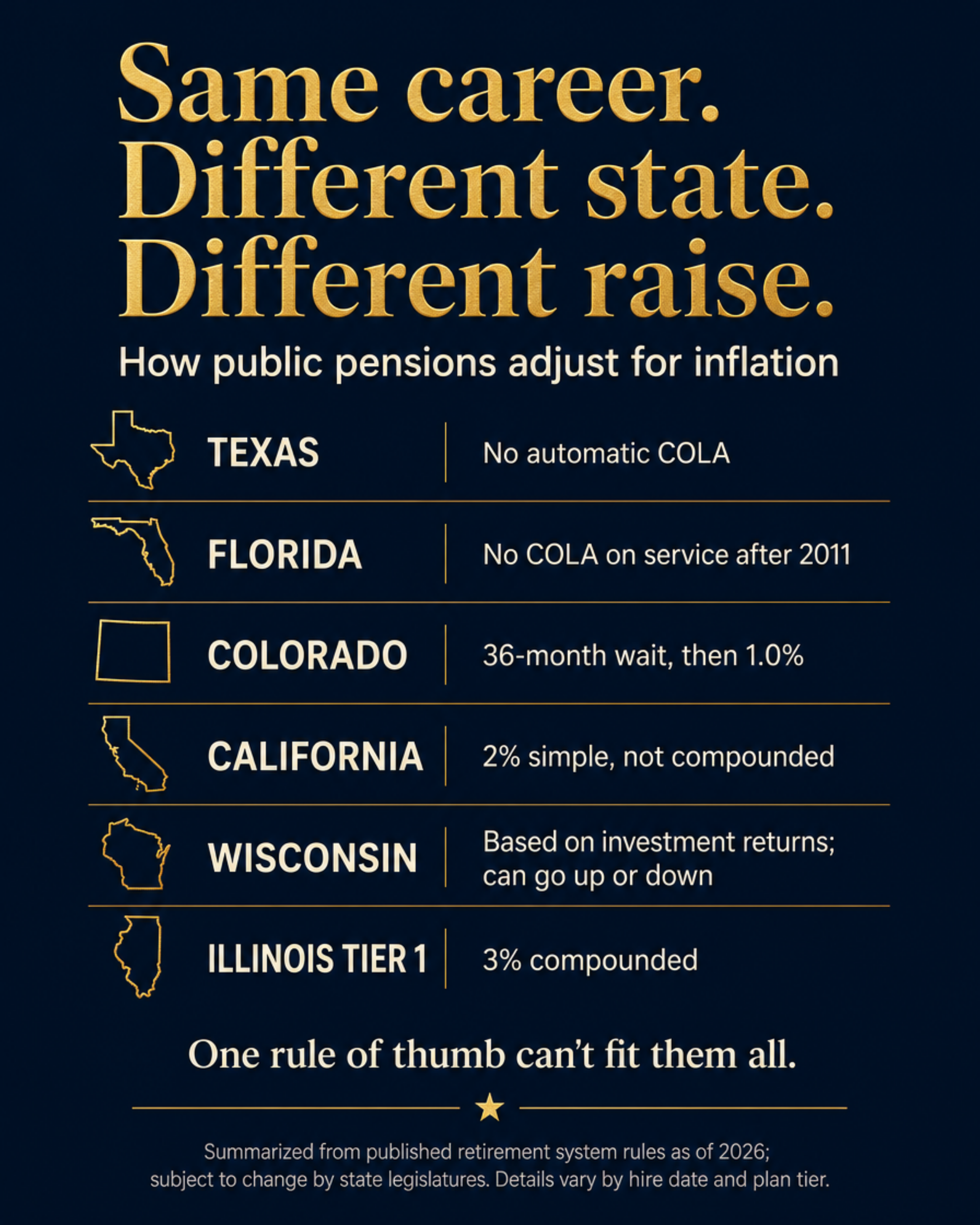
Social Security adjusts every year based on inflation. Public pensions don't follow one rule. Each state sets its own, and the differences are dramatic.
| State (system) | Pays into Social Security? | Cost-of-living adjustment |
|---|---|---|
| Texas (TRS) | Mostly no | No automatic COLA. Voters approved a one-time COLA in 2023—the first since 2013. |
| Florida (FRS) | Yes | No COLA on service earned after July 1, 2011. Members who first enrolled after that date receive no post-retirement COLA. |
| Colorado (PERA) | No | 36-month wait before the first increase. The increase was 1.0% in 2025 and 2026 and can range from 0.5% to 2.0% under the plan's automatic adjustment provision. |
| California (CalSTRS) | No | 2% of the initial benefit each year, simple rather than compounded, plus supplemental payments intended to maintain 85% of purchasing power. |
| Missouri (MOSERS, state employees) | Yes | 80% of the annual increase in CPI, with a minimum of 0% and a maximum of 5%. |
| Illinois (TRS) | No | Tier 1 (hired before 2011): 3% compounded. Tier 2 (hired 2011 or later): the lesser of 3% or half of CPI, simple rather than compounded, starting at age 67 or one year after retirement, whichever is later. |
| Wisconsin (WRS) | Yes | No guaranteed COLA. Annual adjustments are based on the system's investment performance, can be positive or negative, and can reduce prior increases (though not below the original benefit). |
COLA rules as published by each retirement system; subject to change by state legislatures.
The range is enormous: from no increase at all in Texas and for newer Florida members, to a 3% compounded raise for Illinois Tier 1 teachers—and everything in between.
Wisconsin shows how misleading a single good year can be. Because its adjustments follow investment returns, the Core annuity rose 7.4% in 2022—then just 1.6% in 2023. Retirees in the optional Variable fund saw a 15% increase in 2022 followed by a 21% cut in 2023. Even with those strong years included, the system reported that its 20-year average Core adjustment was about 1.6% per year, compared with about 2.6% average inflation over the same period.
Those differences compound over a long retirement. Here is what a $4,000 monthly pension could be worth in today's dollars after 20 years of 3% inflation, depending only on its COLA structure:
| COLA structure | Purchasing power after 20 years |
|---|---|
| Full inflation adjustment | $4,000 |
| 2% simple (not compounded) | ~$3,100 |
| 1% compounded | ~$2,700 |
| No COLA | ~$2,215 |
Hypothetical illustration assuming 3% annual inflation. Does not reflect supplemental or ad hoc payments.
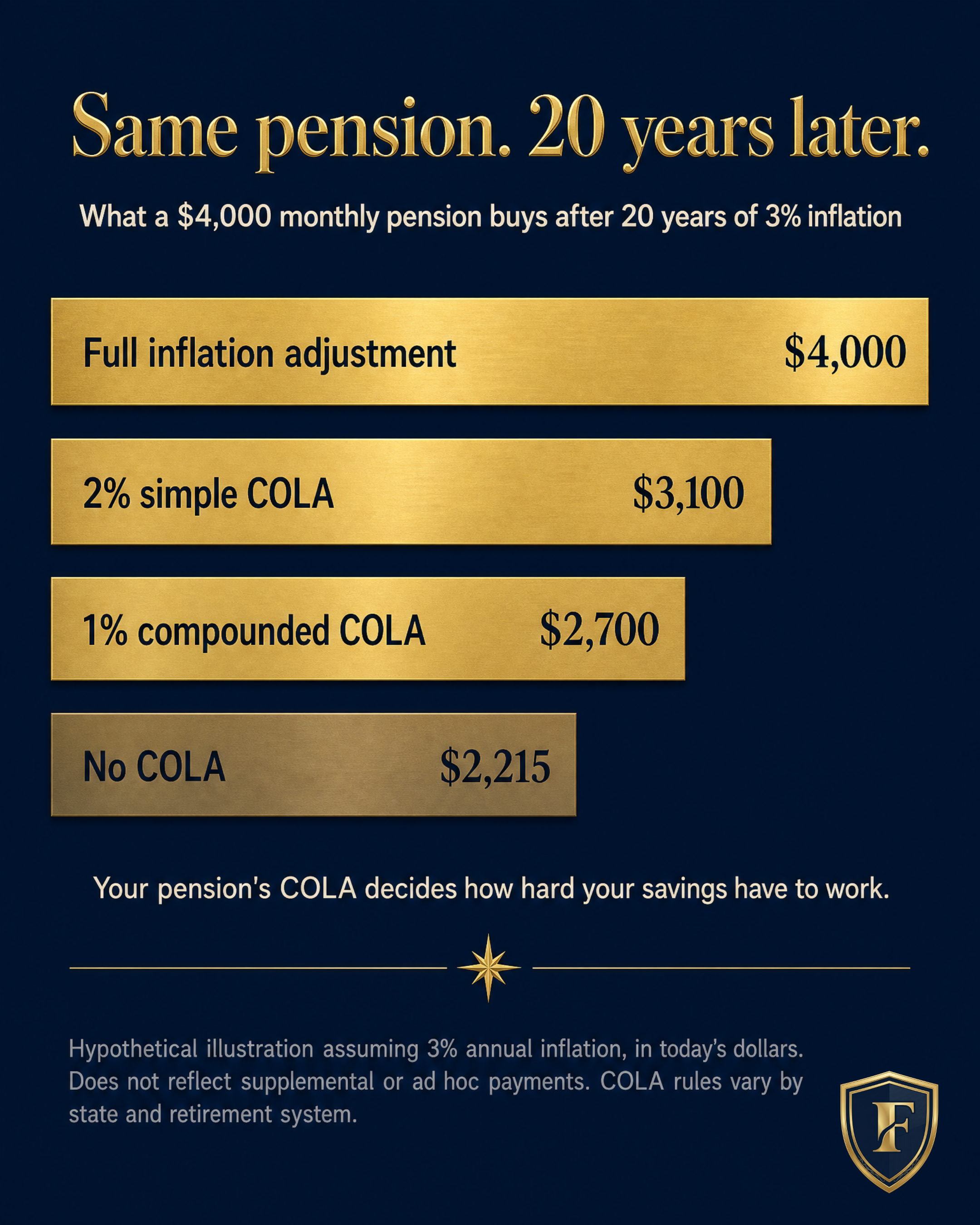
A retiree with no COLA loses nearly half of the pension's buying power over 20 years. That gap has to be filled from somewhere—usually the 403(b) or other savings.
Which means the pension's COLA directly determines how much a retiree can safely withdraw from savings. If the pension loses ground every year, withdrawals from savings have to rise over time just to maintain the same lifestyle. A plan that ignores that will look fine in year one and fall short in year fifteen.
Taxes: Not Every Retirement Dollar Is Taxed the Same
The tax treatment of each income source adds another layer of difference.
At the federal level:
- Pension income and traditional 403(b) withdrawals are generally taxed in full as ordinary income, because the contributions went in pre-tax.
- Social Security is different. Depending on total income, anywhere from none to at most 85% of benefits is subject to federal income tax. Some retirees pay no federal tax on their benefits at all.
At the state level, the differences grow. In 2026, 42 states plus Washington, D.C., fully exempt Social Security from state income tax. Only eight—Colorado, Connecticut, Minnesota, Montana, New Mexico, Rhode Island, Utah and Vermont—tax it at all, and most of those offer significant exemptions. Colorado, for example, lets residents 65 and older deduct all of their federally taxed Social Security.
State treatment of pension and 403(b) income varies far more, from full exemption to full taxation, often depending on age, income and where the pension was earned.
The result: a dollar from Social Security, a dollar from a pension and a dollar from a 403(b) can each leave a very different amount in the retiree's pocket. Which income is drawn, in what order and in which years can change the lifetime tax bill significantly.
Why One-Size-Fits-All Advice Falls Short
Much of the retirement industry still relies on rules of thumb: withdraw 4% of savings a year, hold a 60/40 or 50/50 mix of stocks and bonds, and adjust from there.
Those rules were built around a generic retiree—someone with Social Security, a portfolio and not much else. They weren't designed for someone who:
- may have no Social Security from a 30-year career,
- has a pension with a COLA that is capped, simple, delayed or nonexistent,
- owns a 403(b) that may be losing 2% or more a year to fees, and
- lives in a state that taxes each income source differently.
The 4% rule itself comes from financial planner William Bengen's 1994 research, which tested historical U.S. market data to find a withdrawal rate that would have survived every 30-year retirement period he studied. It was a valuable finding—but it rests on specific assumptions that rarely match an educator's real situation:
- A portfolio-only view. It measures how long a pile of savings lasts. It doesn't account for a pension, its COLA rules or whether the retiree has Social Security at all.
- A specific mix of stocks and bonds, held and rebalanced consistently for 30 years.
- Rigid, inflation-adjusted withdrawals, taken every year regardless of what markets do.
- No fees and no taxes. A 403(b) losing 2% to 3% a year to fees, withdrawn at full ordinary income tax rates, is a very different starting point.
- U.S. market history repeating itself, including the sequence of returns.
And all of that is before human behavior is applied. Real retirees don't spend in a straight line, rarely hold steady through a 30% market decline, and face healthcare costs that often rise faster than general inflation. A rule that ignores those realities can look safe on paper while quietly putting the plan at risk.
Consider two retirees who each withdraw 4% from savings. One has an income floor that rises with inflation. The other has a pension that never rises. On day one, their plans look the same. But the second retiree will need to withdraw more and more from savings just to stand still—often right when markets, health costs or longevity put the most pressure on the portfolio.
In my experience, many retirees and even many advisors treat all retirement income as interchangeable. It isn't. How Social Security works in a given state, how the pension's COLA works and how each source is taxed all feed directly into how much can safely be spent. When those differences are ignored, the problem usually isn't noticed until it's too late to fix easily.
A Better Approach for Educators
A retirement plan for a public-sector employee should start with the income sources themselves, not with a withdrawal rule.
- Know exactly what your 403(b) costs. Find the M&E charge, fund expense ratios, rider fees and surrender schedule. California educators can use 403bCompare; elsewhere, ask your vendor for a full fee disclosure in writing.
- Map your income floor in real dollars. Add up your pension, any Social Security (now unreduced by WEP and GPO) and any other guaranteed income, then project what each will be worth after inflation, based on its actual COLA.
- Plan for the COLA gap from day one. If your pension doesn't keep pace with inflation, decide now which assets will fill that gap—and how.
- Coordinate taxes. Your withdrawal order, the timing of Social Security, potential Roth conversions in lower-income years and even your state of residence can all change what you keep.
- Choose pension survivor options deliberately. The choice is usually permanent, and it shapes your spouse's income for life.
- Only then set your withdrawal rate and investment mix. Once you know what your guaranteed income will and won't do, your savings can be positioned for the job that's actually left.
For many educators, that last step is where the pieces come together. If the pension covers a solid base but loses ground to inflation, the rest of the plan can be built around that fact: guaranteed income where more certainty is needed, and growth assets positioned to keep pace with rising costs over time.
Educators Deserve Their Own Playbook
Teachers, administrators and school staff spend their careers taking care of other people's futures. The 403(b) was created to help make them whole—to fill the gap the pension couldn't.
That still works, but only when the plan is built around how their retirement income actually behaves: which sources rise with inflation and which don't, which are fully taxed and which aren't, and what every layer of fees is costing along the way.
A pension is not Social Security. A 403(b) is not a pension. And a withdrawal rule designed for someone else's retirement shouldn't decide yours.
This article is for educational purposes only and is not intended as individualized investment, tax, legal or insurance advice. Pension, COLA and tax rules vary by state and retirement system and may change. Hypothetical illustrations do not represent any specific product and are not a guarantee of future results; past performance does not guarantee future results. Annuities are insurance products; guarantees are subject to the claims-paying ability of the issuing insurer, and annuities may contain surrender charges and other restrictions. Consult a qualified professional regarding your specific situation.