$25 A MONTH VS. A GOFUNDME: THE REAL COST OF "I'LL GET TO IT LATER"

September is Life Insurance Awareness Month, and I want to tell you about two families I'll never forget. Both remind me why this work matters more than a line item on a budget spreadsheet.
Story One
I recently read a GoFundMe for a father who was killed in a car accident. He left behind a wife and four kids. He was the breadwinner. Now his family is left to figure out how to pay the mortgage, the car payment, the groceries—everything—while grieving. The GoFundMe will help for a few months. Then what?
Story Two
Back in 2019, I met a 27-year-old guy who worked for Adams 12 school district. He had three kids and two stepkids. His wife worked part-time at a small coffee shop. He wanted life insurance because he was worried about the credit card debt they'd built up and knew his family couldn't survive on her income alone.
We sat down at a Panera and worked out a plan: $500,000 in coverage for about $25 a month. (That rate reflected his age and health at 27—premiums are lower the younger and healthier you are when you apply. Your own quote may be higher or lower depending on your age, health, and coverage amount.)
At our second meeting, he brought his mom, who worked in a government position with PERA. When she heard the number—$25 a month—she stopped him right there. She told him life insurance was a waste of money. She'd read books that said so. She named authors. She said he should start a business instead and leave that to his family—that a business would be worth more than any policy.
I asked her: what if the business fails? Most do. She said he was smart, so his wouldn't. I pointed out he didn't have a business. He didn't have an idea. He worked in a school district. She said he was smart with computers. He could figure it out.
He didn't get the policy.
At the time, he, his wife, and their kids were already living with his mom—they hadn't planned to stay there forever, it was just where things stood.
About a year later, in early 2020, he texted me. The credit card debt had gotten worse. He wanted help with a debt management plan, and we were going to talk about life insurance again when we met. We never got the chance.
On March 17, 2020, he slipped on an icy sidewalk, hit his head, and died. He was 28 years old.
Not long after, there were two GoFundMe pages for his family—one from his wife's friends, one from his mom's coworkers—trying to help support his wife and five kids, still living in his mom's house, now without his income at all.
He left behind a family, and debt, that $25 a month could have erased. $500,000 could have been a down payment on a home. It could have wiped out the credit card debt overnight. It might have paid off a townhome outright. We'll never know, because $25 felt like "a lot of money" to someone else in that room.
"Best Life Insurance Out There" Isn't the Same as Checked
Here's a third story, and it's a different problem than the bundle markup above. A California teacher had gone to Primerica to set up an IRA. While he was there, he was sold a $650,000, 30-year term life policy and told it was the best life insurance out there. Nobody ever compared it against other carriers. He was paying $140 a month, with no living benefits.
When we finally ran his numbers against the market, he walked away with a brand-new 30-year term—$1,000,000 in coverage, full living benefits for terminal illness, chronic illness, and critical injury—for $87.56 a month. More coverage, more years left on the term, more benefits, and less than half the price.
A few months later, his wife wanted her numbers checked too. She already had a $1,000,000 policy and was paying over $100 a month. Her new 30-year term came back at $73.48 a month, same $1,000,000 in coverage, plus a children's rider adding $15,000 of coverage on each of their kids.
Neither of them was lied to, exactly. They were just never shown anything to compare against. Being told a policy is "the best" by someone who only sells one company's products isn't the same as it actually being checked against the market. Most people assume their agent already did that work. Often, nobody has.
The "Bundle Deal" That Wasn't
Here's something else worth knowing this month: over the past seven years, I've replaced a lot of old term policies for people—policies they bought years earlier that turn out to now be more expensive than what they could get today, even with fewer years left on the term and none of the living benefits newer policies include.
Most of these people thought they got a good deal because it was "bundled" with their home or auto insurance. That's like assuming a department store is always 40% off—it's not, when the price was marked up before the discount ever hit the tag.
A lot of bundled insurance works the same way. Some agencies mark up the premium on certain carriers, and that extra money doesn't go toward your coverage—it goes to the agent, the admin staff, and the agency itself. Agents who work directly with the insurance company don't add that markup. The price you're quoted is the price the company actually charges. No middleman fee baked in.
The Takeaway:
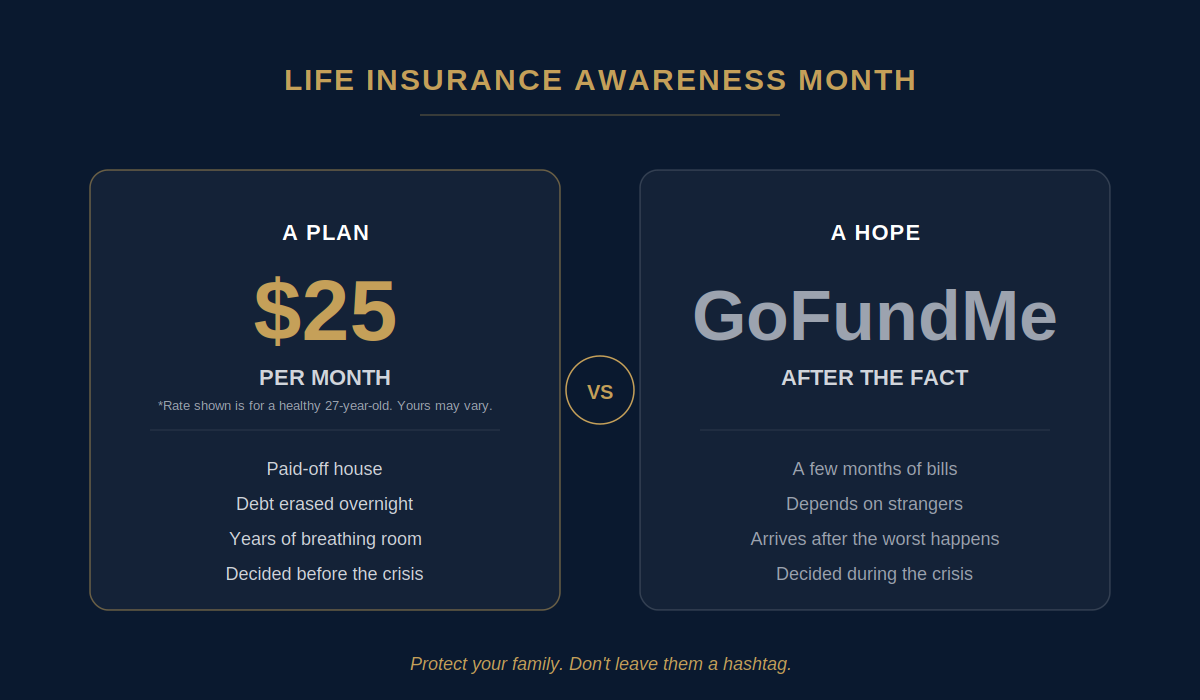
A GoFundMe is not a financial plan. It's a last resort, built on the goodwill of people who can only give so much, arriving only after the worst has already happened. It buys a family a few months. Life insurance buys them years—a paid-off house, a debt-free start, breathing room to grieve without also drowning.
This Life Insurance Awareness Month, Do One Thing
Look at what you actually have. If you have coverage, check if it's still enough for your life today—not the life you had five years ago—and check whether you're paying a marked-up "bundle" price instead of what the carrier actually charges direct. If you don't have coverage, ask yourself honestly what your family would do next month if your income stopped tomorrow. And if someone in your life is talking you out of it "on principle," ask them who's going to pay the mortgage instead.
$25 a month is not a lot of money—though your actual rate will depend on your age, health, and how much coverage you need. A funeral, a mortgage default, and a GoFundMe are far more expensive, no matter what your number turns out to be.
Protect Your Family. Don't Leave Them a Hashtag.
It costs nothing to find out what your family actually needs—and it might be the most important 20 minutes you spend this month.
This article is for educational purposes only and does not constitute investment, insurance, or tax advice. Pricing examples referenced above are specific to the individual's age and health at the time and are not a quote or guarantee of rates for any other person; actual premiums vary by age, health, gender, coverage amount, and policy type. Details from client stories have been shared with permission and/or altered to protect privacy. Please consult a licensed professional before making any financial decisions.