
If you’ve been watching the news lately, you’ve probably seen the alarming headlines about the future of Social Security. The latest Trustees Report gave us a stark reality check: if Congress doesn't act, beneficiaries could face an automatic 22% benefit cut by 2032. As a Financial Specialist and Registered Social Security Analyst (RSSA®), I get asked about this constantly. Clients ask me: “Should I claim my benefits early before the money runs out?” or “Is the government just stealing our surplus anyway?” Let’s separate the political noise from economic reality, look at the two changes Congress is currently debating, and discuss how this impacts your personal retirement strategy.
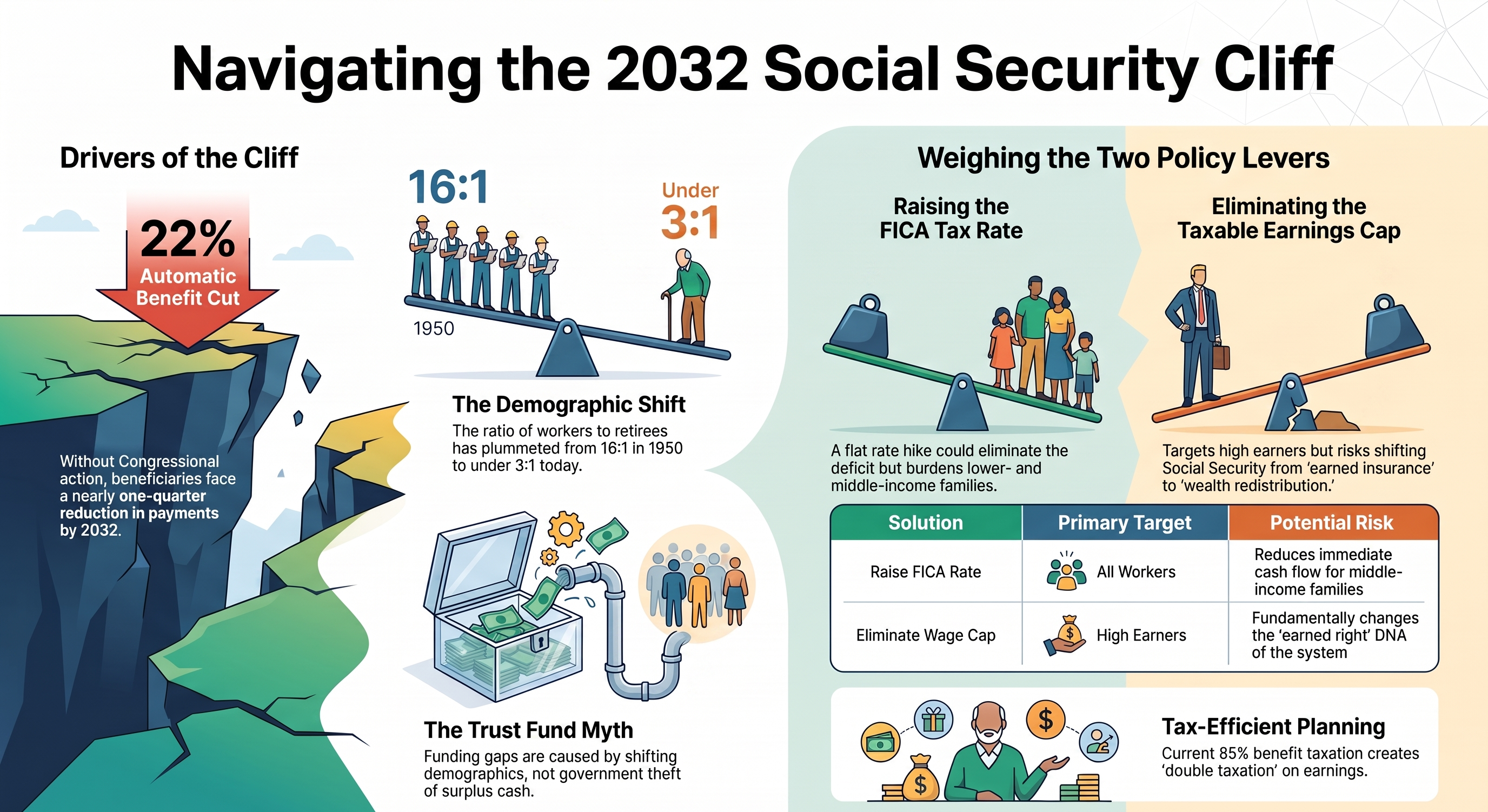
The baseline metrics: Factoring demographic imbalances, Trust Fund realities, and structural policy reform levers into your plan.
The Two Levers: FICA Hikes vs. Lifting the Cap
To fix the funding gap, Washington is weighing two primary options. Both will affect your wallet, but in very different ways.
Option 1: Raising the FICA Tax Rate
This would mean increasing the current 6.2% payroll tax that both employees and employers pay.
The Reality: While a flat rate hike would completely wipe out the long-term deficit, it places a heavier burden on lower- and middle-income families who rely on that immediate cash flow for daily living expenses.
Option 2: Eliminating the Taxable Earnings Cap
Currently, payroll taxes stop once an individual's earnings hit the annual wage cap. Anyone making more than that threshold stops paying into Social Security for the rest of the year, while the vast majority of Americans pay into it on every single paycheck.
The Reality: Lifting the cap targets high earners and captures a massive pool of revenue without raising taxes on 96% of workers. But it creates a dilemma: If a high earner pays more into the system, should they get a massive monthly check in retirement? If we cap their benefits but uncap their taxes, Social Security starts looking less like an "earned right" insurance program and more like a redistribution plan—which changes the political DNA of the system entirely.
The "Trust Fund" Myth: Is the Capital Even Real?
I often hear the complaint that generating more tax revenue is pointless because the government just "borrows" the money to fund regular spending.
But here is the truth behind how the Trust Funds actually work: By law, surplus cash cannot sit idle in a vault where inflation would eat it alive. Instead, it must be invested in special-issue U.S. Treasury bonds. Yes, the Treasury uses the cash, but the Trust Fund gets an interest-bearing security backed by the full faith and credit of the United States.
If the government had kept that money under a mattress and "never touched it," the Social Security Trust Fund would have gone bankrupt decades ago. It is the compound interest on those bonds that has kept the system afloat.
The impending crisis isn't caused by theft; it's caused by demographics—we simply have fewer workers paying into the system for every retiree drawing from it.
The Structural Problem: Double Taxation and the Pay-As-You-Go Flaw
Beyond the immediate financing gap, there are two fundamental realities we have to address if we want a system that is fair and sustainable for the long haul.
First, we need to eliminate the taxation of Social Security benefits entirely. Right now, depending on your provisional income, up to 85% of your benefits can be subjected to federal (and sometimes state) income taxes. This is inherently a form of double taxation. You already paid FICA taxes on those dollars when you earned them; forcing retirees to pay income taxes on those same dollars when they are distributed is fundamentally unfair and directly erodes a senior's purchasing power.
Second, we cannot continue to rely solely on current workers to pay for current retirees. Social Security was built as a "pay-as-you-go" system. In 1950, there were more than 16 workers supporting every single retiree. Today, that ratio has shrunk to under 3 to 1, and it's heading toward 2 to 1. Expecting the next generation of workers to carry the entire weight of an aging population through ever-increasing payroll taxes is an unsustainable economic model. We must find alternative, modernized funding mechanisms that don't just squeeze the current workforce.
| Proposed Policy Lever | Primary Economic Benefit | Strategic Trade-off / Risk |
|---|---|---|
| Raise Flat FICA Tax Rate | Completely covers long-term structural deficit | Disproportionately reduces net income for lower and middle-class households. |
| Eliminate Taxable Wage Cap | Captures massive revenue from top 4% of earners | Alters system's framework from an "earned right" insurance model to a wealth redistribution model. |
| Abolish Benefit Double Taxation | Restores purchasing power directly to retirees | Creates an immediate drop in near-term federal tax revenues that requires budget adjustments. |
What This Means for Your "Metabolism of Retirement"
When I help clients build their retirement plans, we look at Social Security as a vital muscle in the Metabolism of Retirement. It’s the guaranteed, inflation-protected income floor that supports your private wealth and insurance structures.
Even with a worst-case scenario 22% cut in 2032, Social Security is not going to zero. And more importantly, Congress has historically always stepped in at the eleventh hour to protect voters' benefits.
However, because rules, tax thresholds, and retirement timelines are shifting, you cannot afford to guess when it comes to your claiming strategy. Maximizing your lifetime payout requires looking at how your benefits interact with your overall tax-efficient withdrawal plan.
Optimize Your Claiming Strategy
Let’s look at the math together. If you are ready to stop guessing and start optimizing your personal retirement metabolism, let's look at your numbers.